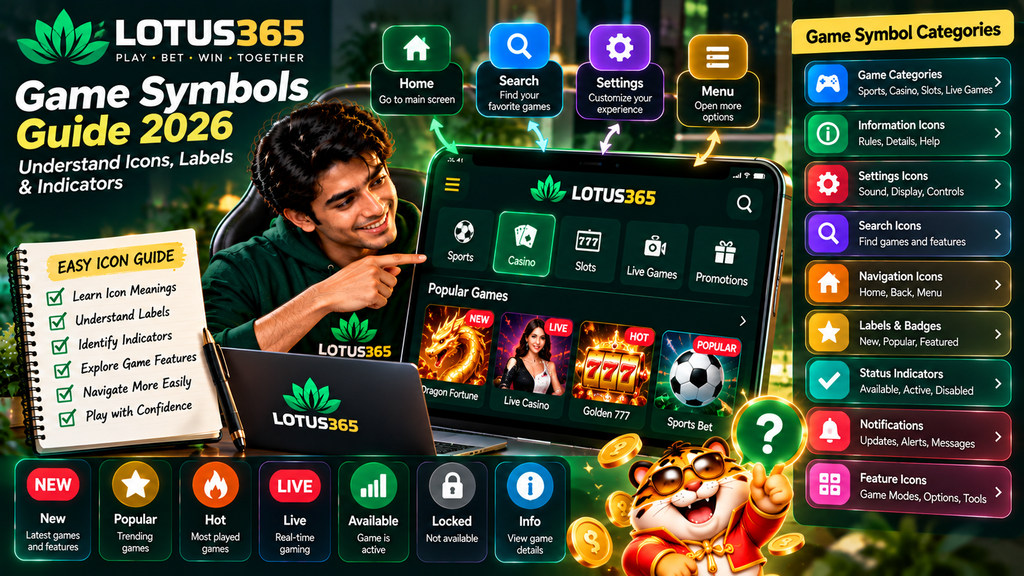
Lotus365 Game Symbols can appear throughout a game interface to communicate information quickly. Icons, badges, buttons, labels, and visual indicators can help users understand available options without requiring long descriptions.
Different games may use different symbols, and the same type of icon can sometimes have different functions depending on where it appears. Therefore, it is useful to understand the general purpose of common interface symbols while checking the information provided for the specific game.
This guide explains common types of game symbols, how to read them, and what users should check before interacting with unfamiliar icons.
What Are Lotus365 Game Symbols?
Game symbols are visual elements used within a game interface to represent an action, category, feature, status, or piece of information.
They may appear as:
- Icons
- Buttons
- Badges
- Status indicators
- Menu symbols
- Information icons
- Navigation controls
- Feature labels
Symbols make interfaces easier to scan because users can often recognize an icon faster than reading a full sentence.
Why Are Game Symbols Important?
A well-designed interface uses visual indicators to make navigation easier.
Game symbols can help users:
- Identify available functions
- Recognize menu options
- Understand interface controls
- Locate information sections
- Identify game categories
- Notice important status indicators
- Navigate between different areas
However, users should not assume that every symbol has the same meaning across every game.
Common Types of Game Icons
Many gaming interfaces contain familiar categories of icons.
Information Icons
An information symbol is commonly represented by a small “i” inside a circle.
It may indicate that additional information is available.
Depending on the interface, selecting it may open:
- Game details
- Instructions
- Rules
- Help information
- Feature descriptions
Always read the information displayed after opening the icon.
Settings Icons
A gear or cog symbol is commonly associated with settings.
It may provide access to options related to:
- Sound
- Display
- Controls
- Language
- Interface preferences
The available settings can vary between games.
Home Icons
A house-shaped icon often represents the home or main screen.
It can help users return to the primary game or platform area.
If several navigation buttons are displayed, check their labels before selecting one.
Search Icons
A magnifying-glass symbol is commonly used for search.
It may allow users to find:
- Games
- Categories
- Information
- Specific titles
The exact search function depends on the interface.
Menu Icons
Three horizontal lines are often used to represent a menu.
A menu can contain additional navigation options that are not visible on the main screen.
Opening the menu may reveal:
- Categories
- Account options
- Settings
- Help
- Other navigation sections
Understanding Game Labels
Not every visual indicator is an icon.
Games may also use text labels to communicate information.
Examples can include:
- New
- Popular
- Featured
- Updated
- Live
- Recommended
- Available
- Information
These labels can provide quick context, but users should still review the actual game details rather than relying only on a badge.
What Do Status Indicators Mean?
Some symbols communicate the current state of an element.
For example, an interface may use visual indicators to show that an option is:
- Available
- Selected
- Disabled
- Active
- Unavailable
- New
Colors may also be used alongside icons.
Because color meanings can vary between interfaces, read any accompanying text when available.
Understand Navigation Symbols
Navigation icons help users move between different areas.
Common navigation symbols may include:
- Home
- Back
- Forward
- Menu
- Search
- Close
- Expand
- Minimize
Before selecting an unfamiliar navigation control, look at the surrounding labels or screen context.
This is particularly useful on smaller mobile screens where several icons may appear close together.
Recognize Game Category Icons
Some interfaces use icons to represent different categories.
A category may be represented by an image or symbol related to its general theme.
For example, different sections could use separate visual indicators for:
- Sports
- Casino
- Slots
- Live games
- Other available categories
The exact categories and symbols can vary, so use the displayed labels as the primary reference.
Understand Feature Indicators
Some games may display symbols next to specific features.
A feature icon might indicate that additional information or functionality is available.
Before interacting with a feature symbol:
- Check its label.
- Open the information if available.
- Read the description.
- Understand what the option does.
- Use the feature only after you understand it.
This can reduce confusion when a game contains many visual controls.
Read Symbols Together With Text
Icons are designed to communicate quickly, but text often provides more precise information.
For example:
Icon + Label + Description
is generally more informative than an icon by itself.
If a symbol is unfamiliar, look for nearby text or an information option rather than guessing its purpose.
Why Symbols Can Differ Between Games
There is no universal requirement that every game use identical interface symbols.
Different developers can choose different:
- Icons
- Colors
- Button designs
- Labels
- Menu structures
- Navigation systems
As a result, becoming familiar with one game’s interface does not guarantee that every other game will use the same symbols.
Check the Meaning of Unfamiliar Icons
When you encounter an unfamiliar symbol, follow a simple process.
Step 1: Look at the Location
Consider where the icon appears.
An icon in the top navigation area may have a different purpose from one displayed next to a game feature.
Step 2: Check Nearby Text
Look for labels, descriptions, or tooltips.
Step 3: Open Information
If an information icon is available, use it to review the relevant explanation.
Step 4: Check the Game Instructions
Some interfaces include instructions explaining their controls and symbols.
Step 5: Avoid Guessing
If the purpose remains unclear, do not assume what the symbol does.
Game Symbols on Mobile Devices
Mobile interfaces often use smaller icons because screen space is limited.
This can make some symbols harder to understand.
When using a mobile device:
- Check the icon carefully
- Look for labels
- Use available menus
- Rotate the screen only when appropriate
- Review instructions
- Avoid tapping unfamiliar controls repeatedly
If an icon is difficult to identify, check whether the interface provides additional information.
Symbols, Badges and Notifications Are Different
These three elements can look similar but serve different purposes.
Symbol: Usually represents an action, category, or function.
Badge: Often highlights a status or special label.
Notification: Usually communicates an alert, update, or message.
Understanding this difference can make an interface easier to navigate.
Check Symbols Before Making Decisions
Visual indicators can provide useful information, but they should not replace detailed game information.
Before making decisions, review:
- Game instructions
- Rules
- Features
- Applicable notices
- Game information
- Available controls
A symbol is usually only one part of the information presented on a game screen.
Keep a Personal Reference for Unfamiliar Symbols
If you frequently explore different games, you can keep a simple reference list.
For example:
Symbol Type General Purpose
Information Opens additional details
Gear Settings or preferences
Home Returns to main screen
Search Finds available content
Menu Opens additional navigation
Back Arrow Returns to previous screen
Close Closes a panel
Star May indicate favorites or highlights
These are general interface conventions. Always confirm the meaning from the specific game interface.
Avoid Assuming Colors Have the Same Meaning
Color is often used to make symbols easier to recognize.
However, the same color may have different meanings across different interfaces.
For example, a green indicator might represent an active option in one interface, while another interface could use green simply as a design element.
Therefore, consider:
- Icon shape
- Label
- Position
- Supporting text
- Current screen context
Rather than relying on color alone.
Quick Lotus365 Game Symbols Checklist
Before using an unfamiliar icon, check:
- What does the symbol look like?
- Where does it appear?
- Is there a text label?
- Is additional information available?
- Does the game provide instructions?
- Is the symbol an action, status, or category?
- Does the symbol change when selected?
- Is the same icon used elsewhere?
- Does the current screen provide more context?
This checklist can help you understand interface elements without guessing.

Frequently Asked Questions
What are Lotus365 Game Symbols?
Lotus365 Game Symbols are visual icons, indicators, badges, and labels used within game interfaces to communicate functions, categories, features, or status information.
Do all games use the same symbols?
No. Different games can use different icons, labels, colors, and interface designs. Always check the information provided by the individual game.
What does an information icon usually mean?
An information icon commonly indicates that additional details, instructions, or explanations are available.
What does a gear icon usually represent?
A gear or cog icon commonly represents settings. Depending on the game, it may provide access to sound, display, controls, or other preferences.
Why are some game icons different on mobile?
Mobile interfaces have less screen space so that icons may be smaller or arranged differently. Some labels may also be hidden to create a more compact layout.
Should I guess what an unfamiliar symbol means?
No. Check the label, surrounding information, instructions, or available help section before using an unfamiliar control.
Are symbols the same as notifications?
Not always. A symbol may represent a function or category, while a notification generally communicates an alert or message.
Conclusion
Understanding Lotus365 Game Symbols can make different game interfaces easier to navigate. Icons, labels, badges, and indicators provide quick visual information, but their meanings can vary between individual games.
When you encounter an unfamiliar symbol, check its location, read nearby labels, review available instructions, and look for additional information before interacting with it. Combining visual indicators with the game’s written information provides a clearer way to understand the interface.
Suggested Internal Links
Add natural internal links to your existing articles:
- Lotus365 Game Information Guide 2026
- Lotus365 Game Provider Guide 2026
- Lotus365 Game Updates Guide 2026
- Lotus365 Game Error Message Guide 2026
- Lotus365 Game Language and Display Settings Guide 2026
- Lotus365 Game Search Guide 2026
Internal links are useful for connecting related pages and helping users and search engines understand the relationships between your site’s content.